Reportcards
Reportcards website: a site a parent can actually try
The public site for a coaching centre in Jaipur: courses, 31 guides for parents, 23 quiz pages, student accounts and practice tests that run in the browser.
At a glance
The problem
The old site talked about the centre but gave a parent or a student nothing to actually try.
What I built
A site built from the centre's seal, browser practice tests, sign-in by email code, and pages for what Jaipur families search.
What changed
My audit engine's score went from 76 to 93; site health across the wider SEO work went from 69 to 88.
Read the transcript
This is the Reportcards website, and why it works the way it does.
The old website talked about the centre. But it gave a parent, or a student, nothing to actually try.
So I rebuilt it around the centre's own seal, with something real behind every button.
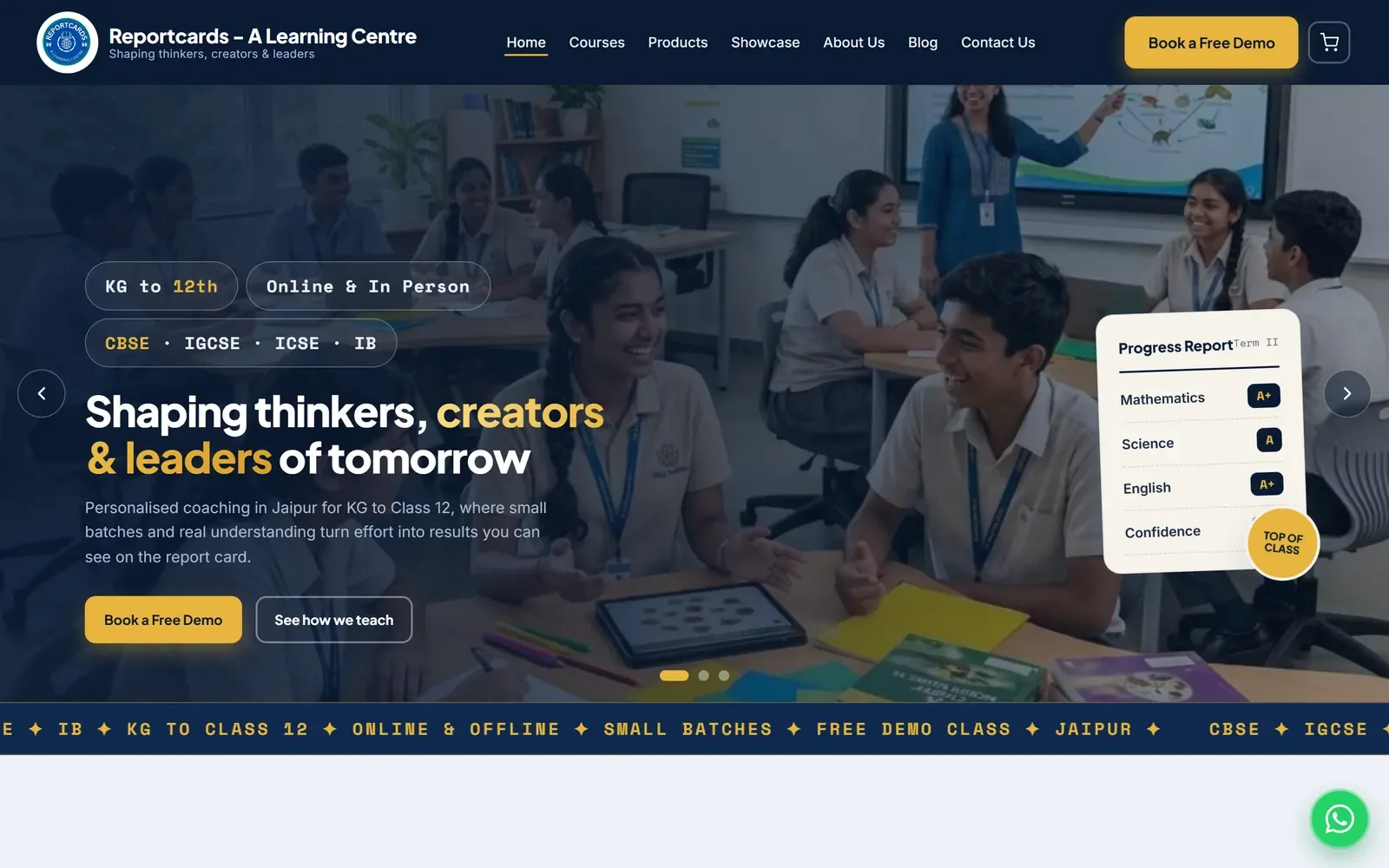
The hero shows a report card, not clip-art. The business is named after report cards.
Gold is kept for one job: the button that books a free demo class.
Practice tests run right in the browser, with no sign-up. Hosting them costs nothing.
I added pages for exactly what Jaipur families search for: C.B.S.E., I.C.S.E., I.G.C.S.E. and I.B. tuition.
Across the technical S.E.O. work, the site health score went from sixty nine to eighty eight.
Why the website looks like this
Every element on the home page has one job
A parent decides in a few seconds whether a coaching centre is serious. The home page is built to answer that before they scroll.
Read the home page
The home page as it is live on reportcards.in.
- A report card, not clip-art
The centre is named after report cards, so the hero shows one: grade chips and a Top of Class stamp. It tells a parent what they will get in one picture.
- Gold means act
Yellow from the seal is kept for calls to action only, so Book a Free Demo is the one warm thing on a cool page.
- Facts in a monospace
Boards and classes sit in small mono chips, like entries in a ledger: quick to scan, hard to miss.
- The ticker is the divider
A running strip of programme facts separates sections, so the things a parent checks first (boards, classes, small batches, Jaipur) stay in view.
Decisions, and why
Two golds, not one
Gold text on light backgrounds uses a darker gold; the bright gold stays for buttons, decoration and gold on dark panels.
Why: Small bright-gold text is hard to read. The darker gold measures 5.03 to 5.43 to 1 against the light backgrounds it sits on.
Tests that run in the browser
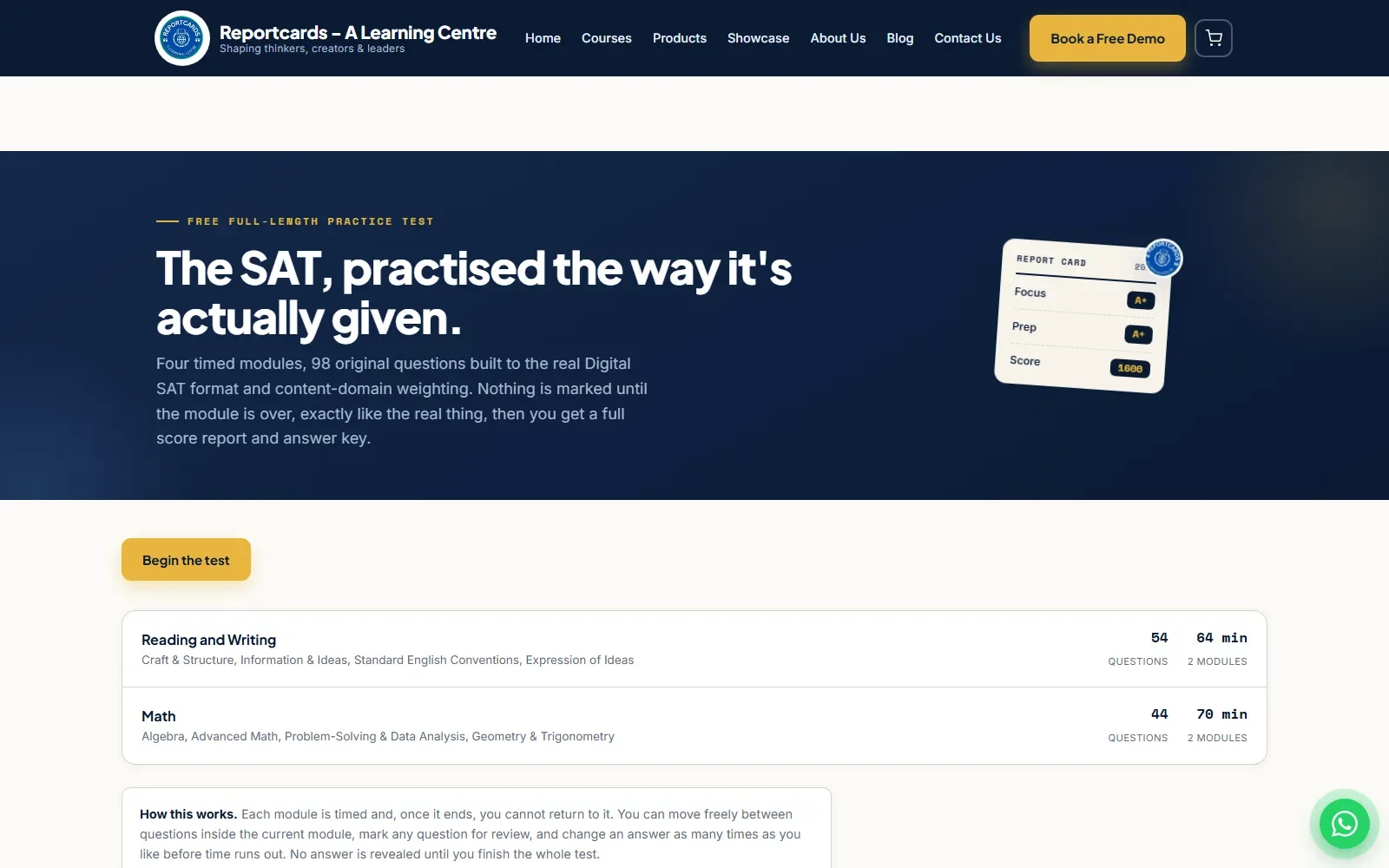
The quiz hub's core tests need no sign-up and run entirely in the page, including a full four-module SAT with 98 questions.
Why: A parent or student gets something real to try for free, and hosting a test costs nothing because the browser does the work.
Codes, not passwords
Students sign in with a one-time code sent to their email. Scores, badges and streaks attach to the account.
Why: Children forget passwords. A code turns a one-off quiz into a reason to come back without anyone managing logins.
Pages for what families search
Ten landing pages for the searches Jaipur families actually make: CBSE, ICSE, IGCSE and IB tuition, a free demo class, fees, small batches.
Why: The site talked about the centre. These pages answer the exact question a parent types before they have heard of it.
A visitor's path
A parent searches for IGCSE tuition in Jaipur and lands on a page made for that search.
They open a practice test in the browser. No sign-up needed.
A student signs in with an email code; the score, badge and streak are saved.
The gold button books a free demo class.
The numbers
Walk through it
Website
The public site at reportcards.in carries the centre's courses, a bulletin, a showcase of student work and 31 guides for parents as of October 2026. In October I added 10 landing pages for what Jaipur families actually search: CBSE, ICSE, IGCSE and IB tuition, a free demo class, how fees are decided, small batches, IGCSE English 0500 classes and the Adarsh Nagar centre itself.
Accounts and grading
Students sign in with a one-time code sent to their email. Signed in, a quiz score is saved to their account and earns a badge: one for finishing, then bronze at 70 percent, silver at 80 and gold at 90 on a quiz of five or more questions, with daily streaks on top. Shop enquiries are recorded as orders with receipts, and a staff area lets the team mark them paid or delivered. Written papers are marked against a rubric by a scheduled worker, and the results land in the staff area. Accounts and paper grading went live at the end of September 2026.
Practice tests
The quiz hub holds 23 quiz pages as of October 2026: six core tests (Grade 2 maths and division, Grade 3 multiplication, English grammar, IGCSE literary devices and a full SAT) and 17 vocabulary day quizzes that open on a release schedule. The core tests run in the browser with no sign-up, and on the five shorter ones, signing in saves the score to the student account. The SAT is modelled on the real exam: four timed modules, 98 questions, one question per screen, mark for review and an estimated score out of 1600 with a breakdown by skill, kept in the browser rather than an account.
SEO
On 5 October 2026, my own audit engine scored reportcards.in 93 out of 100, up from 76 on 29 September. That round of work added the 10 landing pages and fixed titles, descriptions and links across the site. Part of the rise came from the engine itself no longer counting the private login and account pages as errors. These are audit scores, not traffic or rankings.
Across the wider technical SEO work on content, images, schema, performance and local signals, the site health score went from 69 to 88.
Need something similar?
Tell me what your team does by hand today and what the finished system needs to do. I will tell you whether an automation, a custom tool, a portal or a website is the right shape.