







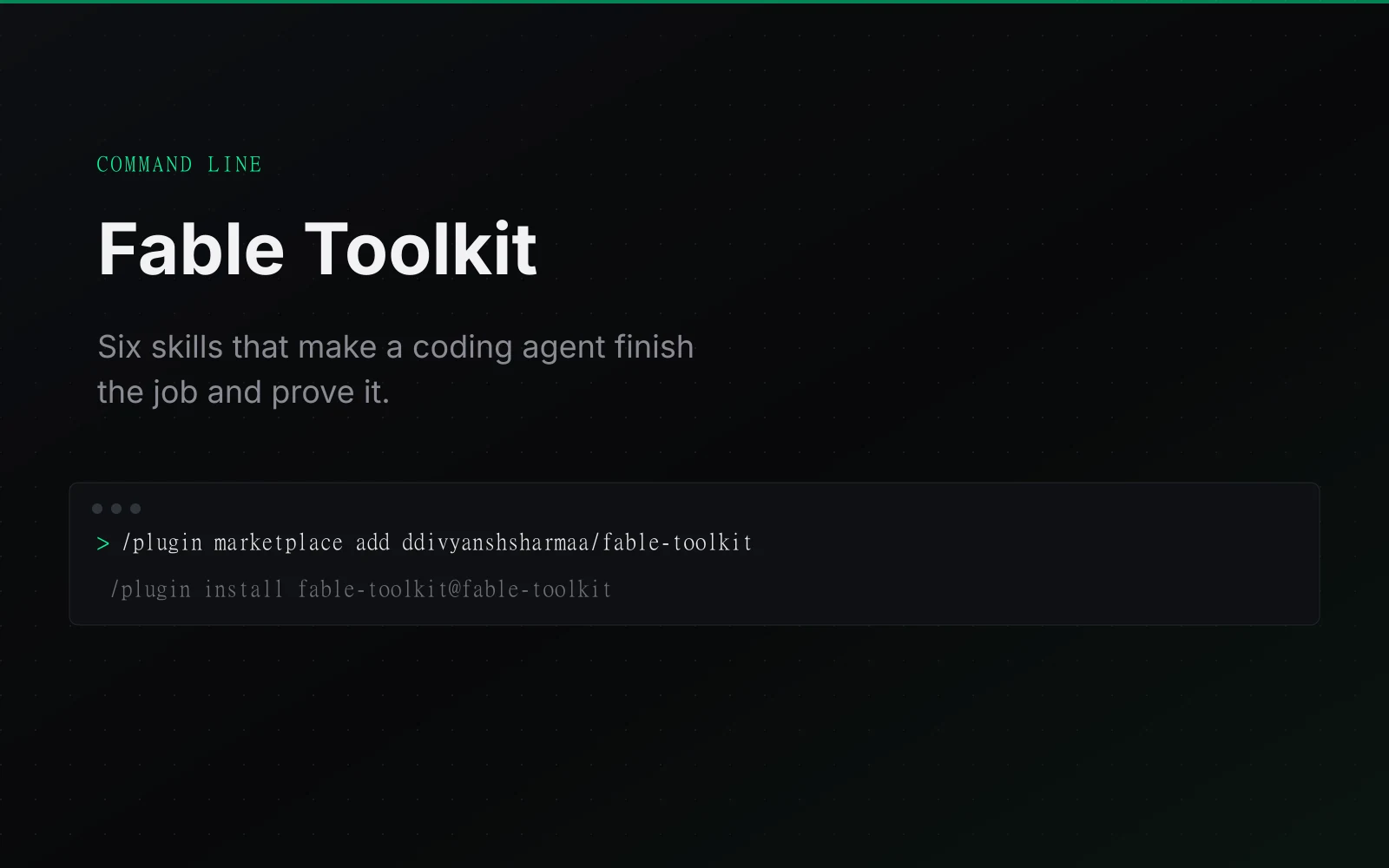
Fable Toolkit
A free Claude Code plugin that makes AI coding agents finish the job and prove it works.
The problem
Most coding-agent failures are not intelligence failures, they are process failures. The model stops half way to ask a question nobody is there to answer, or it writes a file and calls that done, or it fans work out to subagents and repeats their optimistic summaries without checking one of them. Knowing the right process does not help if you have to remember to ask for it every time.
What it does
A public Claude Code plugin: seven skills and four agents built around a single behaviour. Finish the job, then prove it works. Includes multi-engine loops that hand implementation to Codex or Gemini while Claude stays the orchestrator and reviewer.
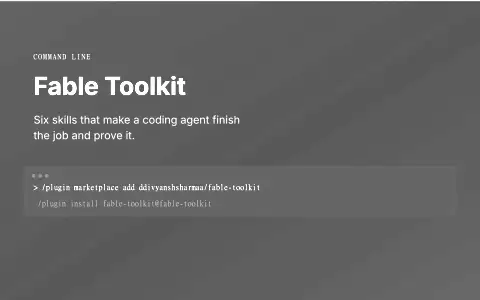
Installable as a plugin, or copied in by hand. The only external dependency is the CLI of whichever engine you want in the loop.
Who it is for
Developers who use Claude Code and want it to stop halfway less often and check its own work.
What it does, feature by feature
- /fable. A working mode for big tasks: run to completion, report the outcome first, never call something done without evidence.
- /orchestrate. Splits work into independent parts, briefs subagents properly, then checks what they claim.
- /deep-check. Verifies a claim with evidence and returns CONFIRMED, PLAUSIBLE, UNVERIFIED or REFUTED, plus what it did not check.
- Multi-engine loops. /trio, /duo-codex and /duo-gemini let Claude write the spec and review while Codex or Gemini writes the code.
- Four agents. Verifier, researcher, worker and critic, ready to use.
- Operating manual. A plain-text method file that smaller, faster models can load in every session.
- Free. Installs as a plugin, with no API key, server or paid service.
- /team. An entry point for the seven skills: fable, orchestrate, deep-check, trio, duo-codex, duo-gemini and team. One-line installers set up the toolkit.
Why it is built this way
Written as skills, so Claude Code loads the relevant one when the situation calls for it instead of depending on anyone remembering. Seven skills and four agents: an operating mode that runs to completion and reports outcome first, an orchestration skill that writes cold-start-complete briefs and spot-checks what subagents claim, and a verification skill that returns CONFIRMED, PLAUSIBLE, UNVERIFIED or REFUTED with proof and a mandatory list of what it did not check. A plain-markdown operating manual sits alongside them. Nothing needs an API key, a server or a paid service.
What was hard
Getting acceptance criteria to be unfaultable. A criterion like "add tests" invites a stub, while "at least one test per exported function, each asserting on a return value" forbids one in advance, so the skill ships a table of vague versus checkable phrasings rather than trusting the reviewer to notice. The other lesson came from parallelism: two engines writing the same file is the most expensive failure in the loop, so briefs now assign file ownership up front. Escalation had to be made structural too: round two changes the model tier or splits the brief, round three the orchestrator takes over, and after that the criterion is reported as failing rather than quietly loosened.
Outcomes
- 7 skills, 4 agents
- Evidence-gated "done"
- No API key needed