

Arun Silver
Bilingual wholesale catalogue website
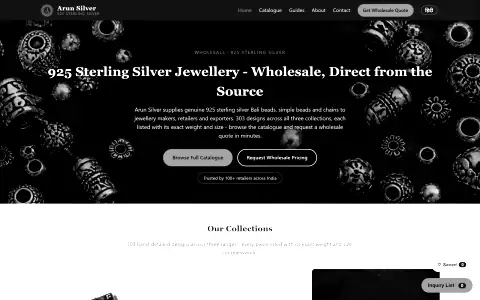
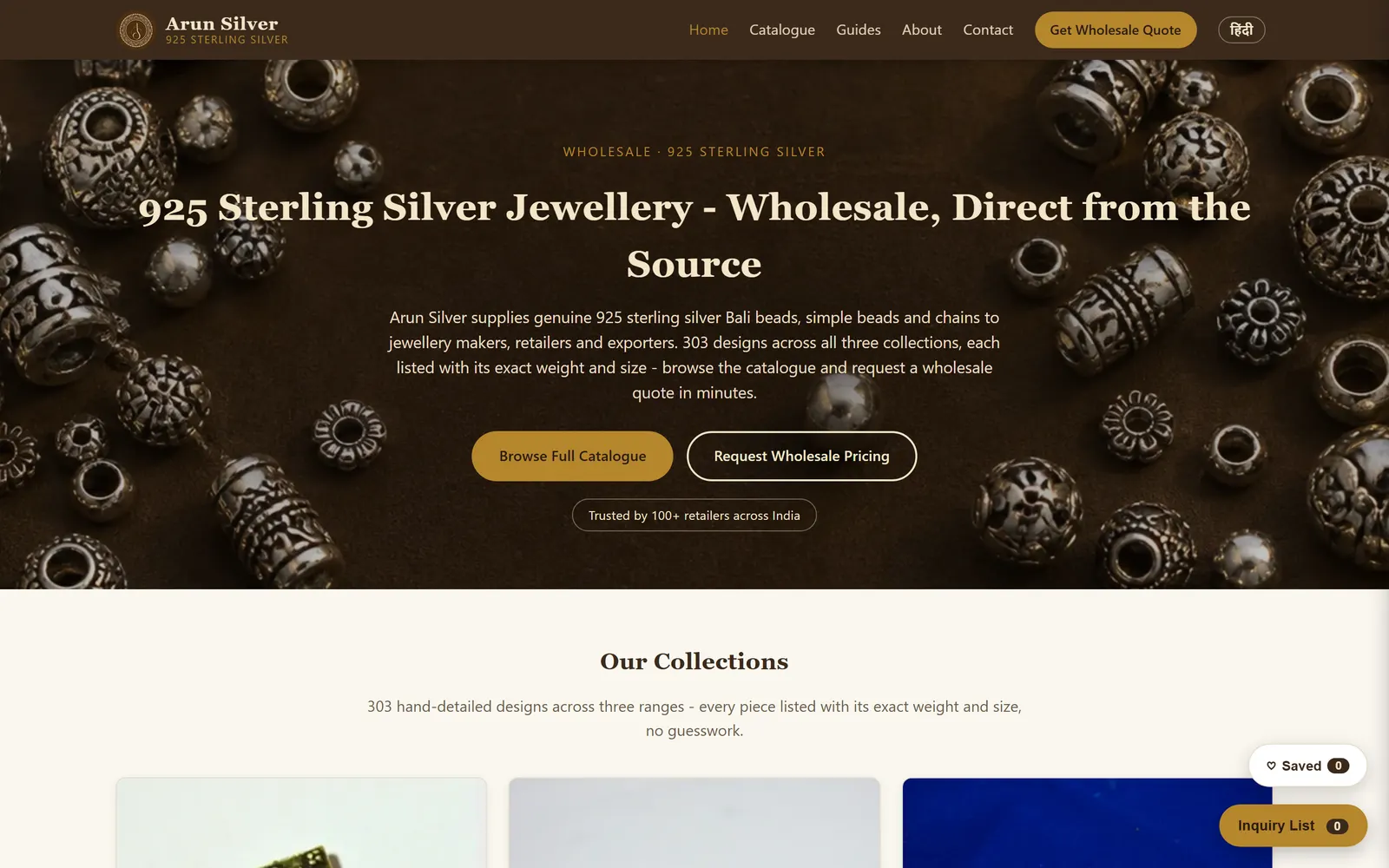
A bilingual wholesale catalogue for a silver supplier: 439 designs, no prices, and inquiries that go straight to WhatsApp.
Walk through it
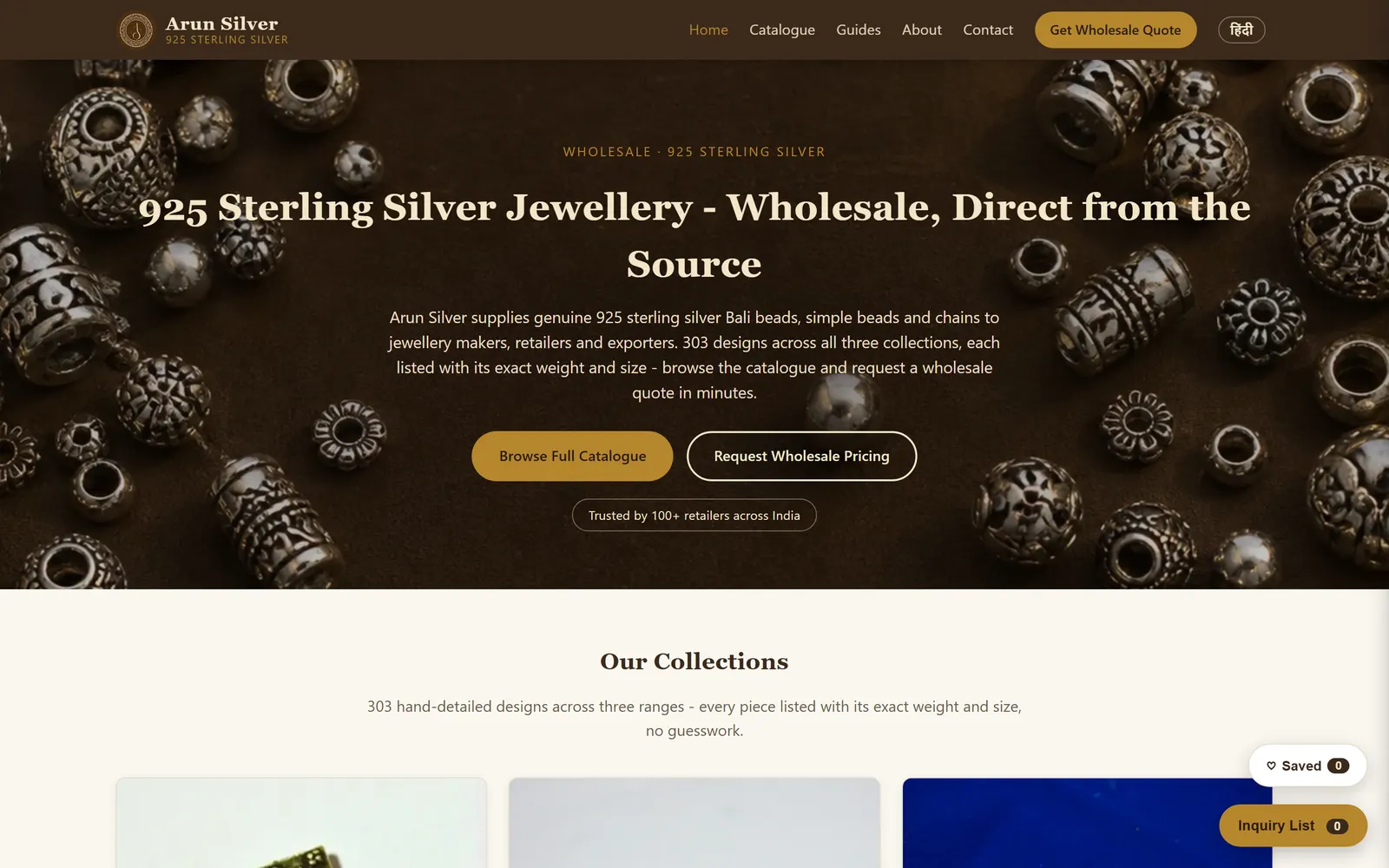
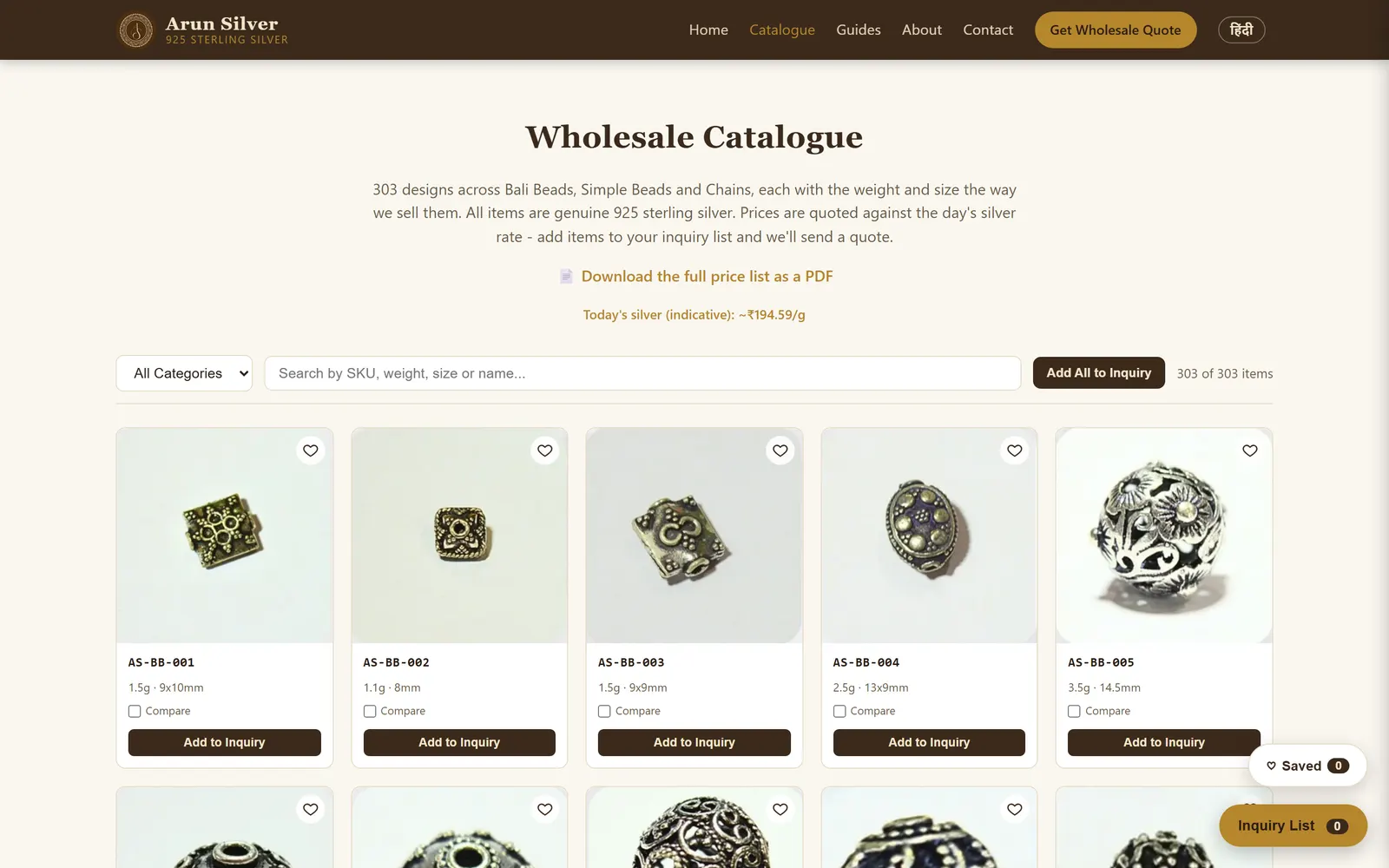
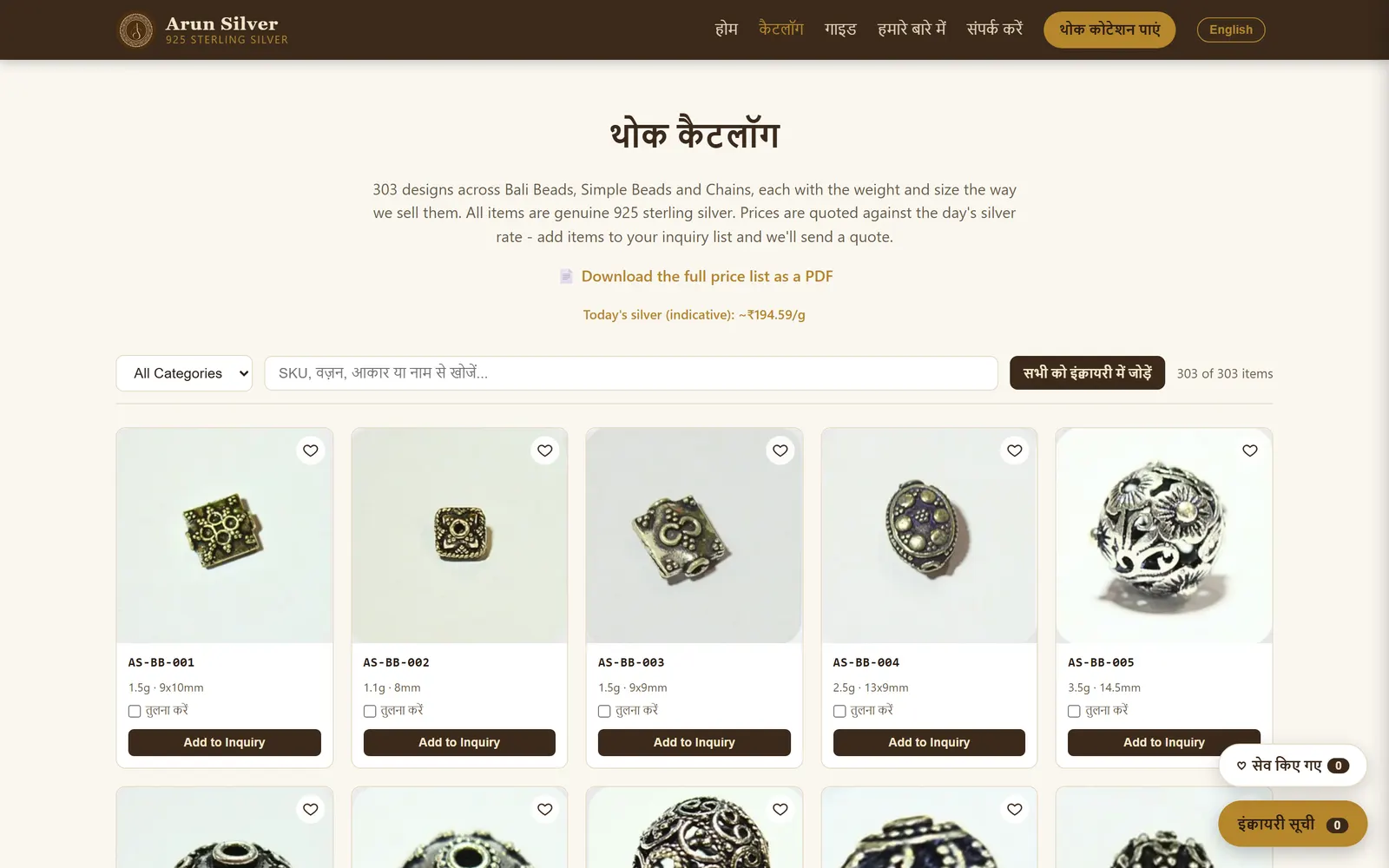
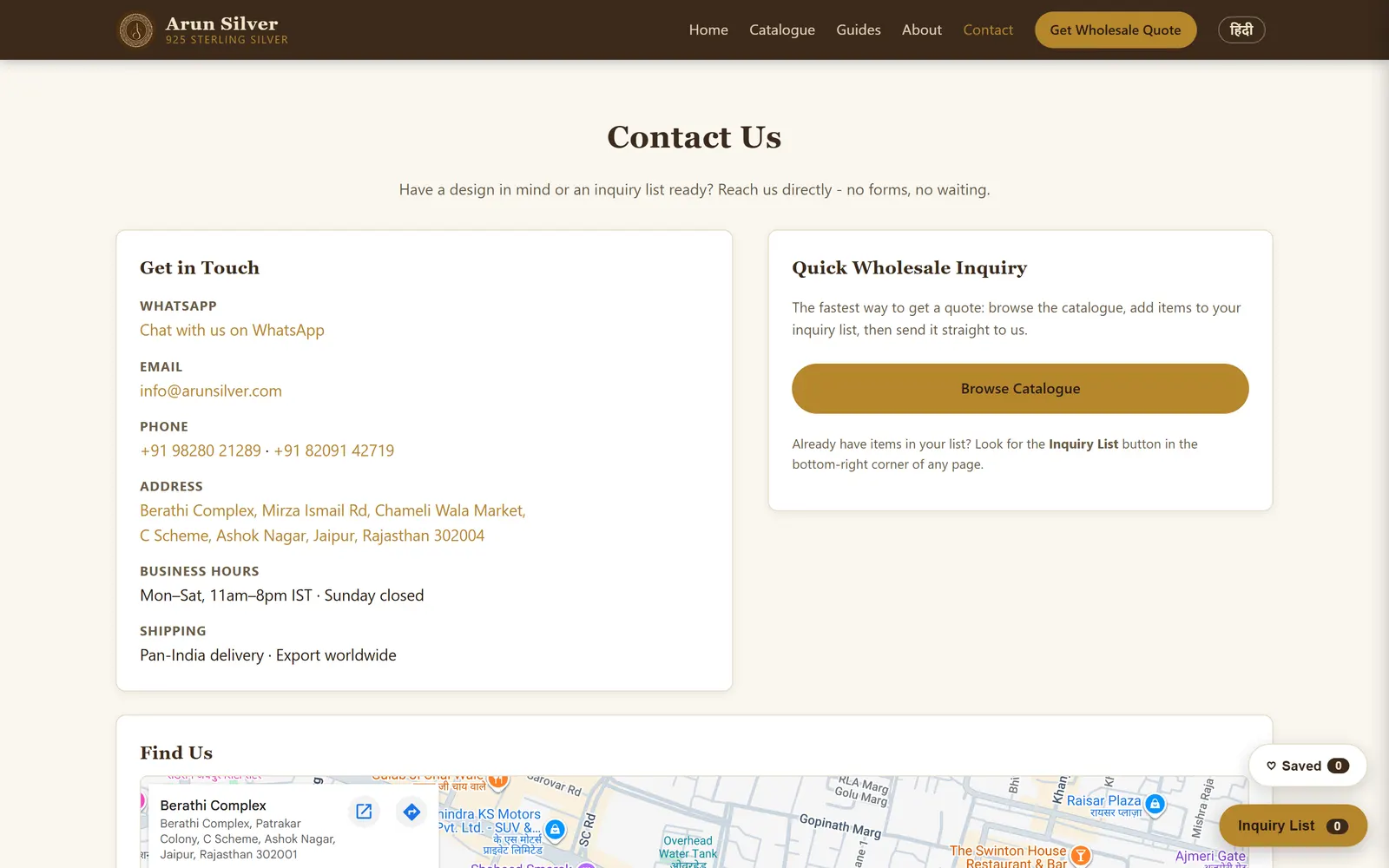
The problem
A Jaipur wholesaler of 925 sterling silver needed a catalogue without fixed product prices. The interface supports English and Hindi.
What it does
As of October 2026, the bilingual catalogue has 439 product pages across 10 collections. Each product has a SKU and its available specifications, with watermarked photos, search and filtering.
The catalogue uses an inquiry list instead of fixed product prices.
Who it is for
Wholesale buyers and retailers ordering 925 sterling silver in bulk, in English or Hindi.
What it does, feature by feature
- Full catalogue. 439 designs across 10 collections, each with its own page, SKU, available specifications, and watermarked photos.
- Search and filters. Find a design by SKU, collection or tag, with a lightbox for every photo.
- Inquiry list instead of a cart. Buyers collect designs and quantities, then send the list on WhatsApp, already filled in with SKUs.
- Stored inquiries. Every inquiry and lead is also saved on the server, with rate limits and bot filtering.
- English and Hindi. The whole interface switches language from one translation table.
- Admin panel. A password-protected page to see inquiries and mark designs sold out across the site.
- Built to be found. Product and BreadcrumbList schema on product pages, buyer guides on the blog, and a downloadable PDF catalogue.
Why it is built this way
Buyers build an inquiry list in local storage without an account and send SKUs and quantities over WhatsApp. Email is a separate contact flow. Pricing follows the day's silver rate and buyers ask for a quote.
What was hard
The client previewed the site by opening the folder from their desktop, where there is no server and fetch() cannot read a JSON file. The build script writes the catalogue twice (products.json for the deployed site and products.js as a plain script global) so the same pages work from a file:// URL. The hero image took several attempts too: tiled thumbnail grids read as boxes of separate photos, and a hand-composited flat-lay looked amateurish. What worked was generating a real studio flat-lay from a text brief, then cropping and darkening it for text contrast. A security and SEO pass after launch found real problems, not hypothetical ones: the admin rate-limit check had a genuine race condition, reproduced with a concurrent-request simulation before it was trusted, and the catalogue page looked complete to a visitor but was almost empty to a crawler because its 439 products only existed after client-side JavaScript ran. Both are fixed now: the rate limit runs inside one database transaction, and the catalogue renders its full product grid as real HTML before any script executes.
How it is set up to be found
By 21 August 2026, the sitemap listed 321 URLs, 303 of them product pages. As of October 2026, it has 497 sitemap URLs and 36 buyer guides. Product pages carry Product and BreadcrumbList structured data, with visible FAQs. The 2026-10-05 SEO pass added /no-minimum-order-wholesale, /export-shipping and /faq. On 5 October 2026, my own audit engine scored the site 94 out of 100, up from 90 on 29 September. That is an audit score, not traffic or rankings.
Outcomes
- 497 sitemap URLs as of October 2026
- 439 product pages in 10 collections
- 36 buyer guides as of October 2026
Stack
Need something similar?
Tell me what your team does by hand today and what the finished system needs to do. I will tell you whether an automation, a custom tool, a portal or a website is the right shape.